5 · minor arcana · swords
Five of Swords
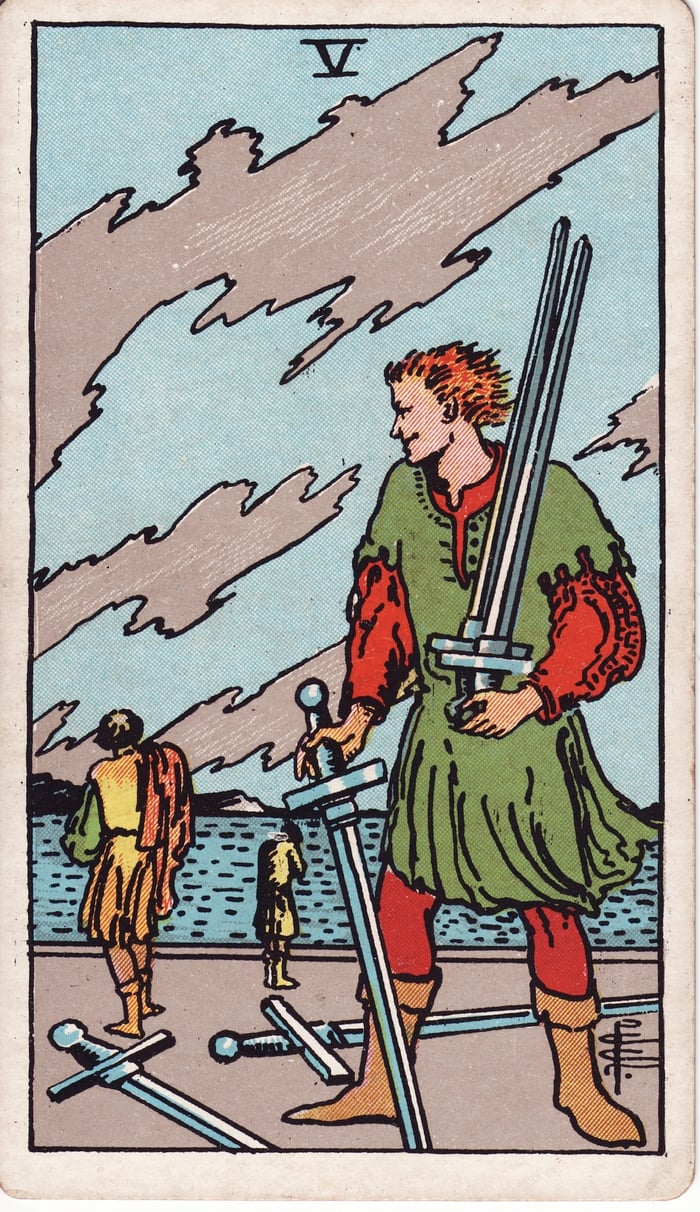
At its heart, the Five of Swords deals with conflict, power dynamics, and the cost of winning. It asks: What did you gain—and what did you lose?
Five lenses on this card. Pick one.
Jungian, symbolic, individuation-focused
Archetypally, the Five of Swords represents ego inflation vs. shadow integration.
Psychological themes:
- The Trickster or Shadow acting defensively
- Fear-driven competitiveness
- Projection: “I must defeat you so I don’t feel weak”
- Internal conflict between values and survival instincts
This card asks:
- Where does my need to win come from?
- What part of myself feels threatened?
- Am I identifying too strongly with the ego?
In this school, the Five of Swords isn’t “bad”—it’s diagnostic, revealing where the psyche is out of balance.
Number Significance
Across tarot, Five is the number of disruption and challenge.
Core Numerological Themes of Five:
- Instability after structure (4 → 5)
- Change, friction, testing
- Crisis that forces growth
- Conflict as catalyst
In the Minor Arcana:
- Fives break comfort
- They expose flaws in systems, beliefs, or relationships
- They are necessary—but uncomfortable—turning points
Symbolically:
Four builds the foundation.
Five shakes it to reveal what’s weak.
In the Five of Swords, this disruption occurs in:
- Thought
- Communication
- Power dynamics
- Ethics and integrity
Synthesis
The Five of Swords is not just “conflict”—it is conflict that teaches discernment.
It asks:
- What kind of person do you become when challenged?
- What price are you willing to pay to be right?
- Can you walk away without proving anything?