7 · minor arcana · swords
Seven of Swords
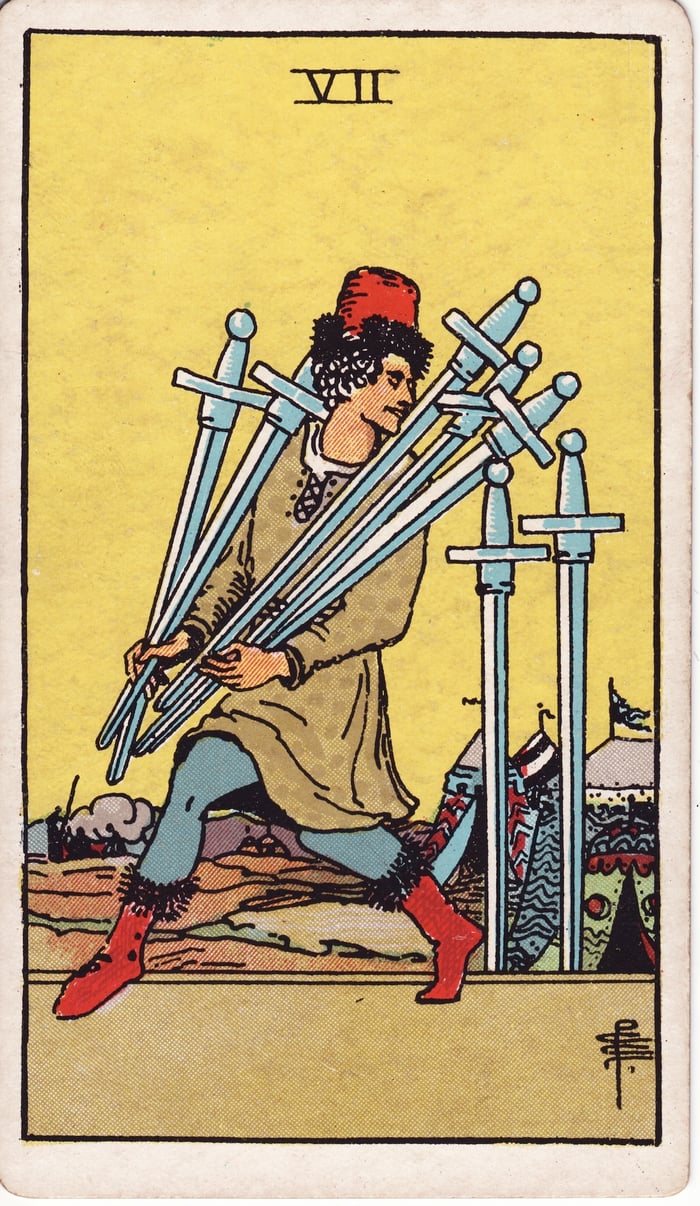
The Seven of Swords represents strategy, secrecy, avoidance, or deception—but at its core, it is about how we navigate situations where direct confrontation feels unsafe or unwise. This card can signal cunning intelligence or self-protective evasion, depending on context.
It asks: Are you acting strategically—or evasively?
Five lenses on this card. Pick one.
Jungian, shadow strategy and avoidance
Archetypally, the Seven of Swords represents the Trickster or Shadow Strategist.
Psychological themes:
- Avoidant coping
- Self-deception
- Fear of vulnerability
- Strategic intelligence
In Jungian terms:
- The shadow expresses itself through manipulation or concealment
- The ego may rationalize dishonesty for protection
This card marks:
The psyche navigating fear through strategy rather than openness.
Number Significance
Core Numerological Themes of Seven:
- Testing
- Strategy
- Evaluation
- Inner challenge
In the Swords suit (Air, mind, communication):
- Seven represents mental strategy under pressure
- Truth is examined—or avoided
Seven is:
The mind testing its own integrity.
Synthesis
The Seven of Swords is not automatically betrayal — it is strategy under tension.
It asks:
- Am I protecting myself—or undermining myself?
- What truth am I avoiding?
- Is my strategy aligned with my values?
Where:
- The Five of Swords shows open conflict,
- The Nine of Swords shows internal distress,
The Seven of Swords reveals:
The quiet maneuvering between confrontation and collapse.
It teaches that intelligence can protect—but only when aligned with integrity. Strategy is powerful, but avoidance eventually demands reckoning.